

Hello, friends. I trust you had a lovely, restful Easter weekend?
If you were checked out for the weekend, don’t forget to check back on Saturday’s “happy feet” post. Lots of good info there.
This week is going to be fun! For the next five days we are busting out our stack of 4″x4″ fabric squares I am going to walk you through different stitches, seams and sewing techniques. It’s a LOT. I want to teach you why all those adjustment dials on your machines matter and how they can make a stitch useful or not useful for a variety of applications. This is going to be a great way to introduce you to some possibly new techniques that will be helpful as you advance your sewing experience.
Here is a rundown of our week:
Tuesday: straight & zigzag stitches
Wednesday: seams of all kinds
Thursday: marking & darts
Friday: tucks & pleats
Saturday: shirring
That’s a whole lot of information for one week!
Let’s get started with today’s lesson:
STRAIGHT STITCHES
The straight stitch is the most basic stitch. And while a lot of y’all have admitted to struggling to sew a straight line, this is still a great place to begin. So, grab a couple of fabric squares and make sure your machine is threaded with contrasting thread (it will be easier to see what’s going on this way) and let’s get stitching!
Start with your stitch length set at 1 and, pressing the foot pedal down gently and keeping the edge of your fabric in line with the 5/8″ seam guide, stitch all the way across your square. (You can practice this several times on several squares and then just paste your best square into your book, so feel free to be liberal with your square usage – practice a lot!)
(And may I remind you to be sure all of your pretty little squares are pressed nicely? This will all feel (and go) so much better if you are wrinkle-free!)
Here’s your video:
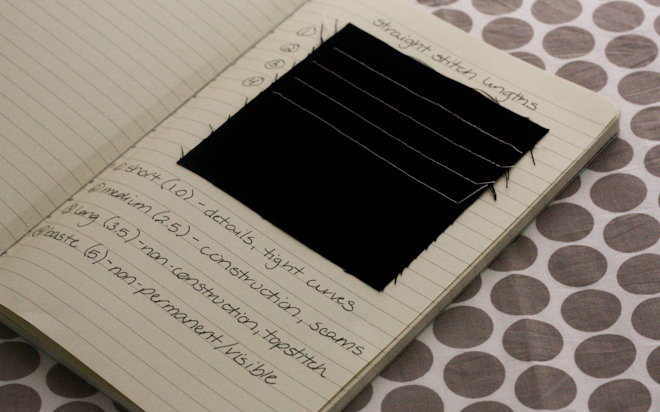
And here’s a shot of what the first page in your book should have in it:
For Review:
1. short stitch (1.0) – for tight curves, details, etc.
2. medium stitch (2.5) – construction/seams; most common
3. long stitch (3.5) – non-construction, topstitching, speed
4. basting stitch (5) – temporary construction, to be removed
ZIGZAG STITCHES
Okay, time to switch your stitch setting to ‘zigzag’. Zigzag stitches can be used for all sorts of reasons. A very short, narrow zigzag stitch is actually what makes a buttonhole. Zigzag stitches can be decorative, or useful for attaching two ends of elastic in a waistband. It’s also useful for appliquéing decorative elements onto a project to ensure that the raw edges don’t fray.
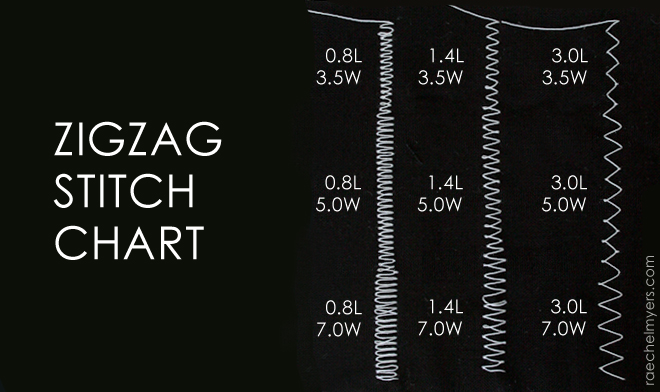
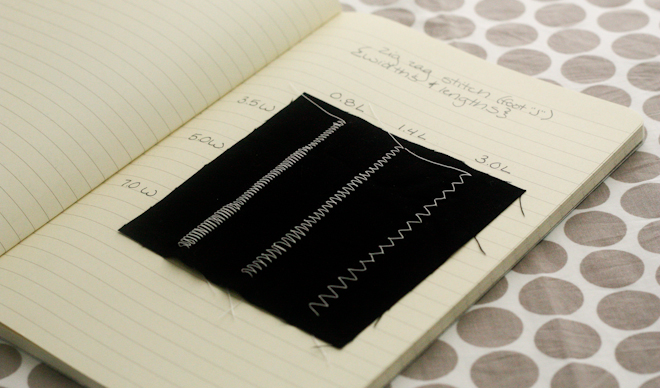
I want you to play with the zigzag stitch a lot today because it will get you comfortable with playing with and understanding your machine settings. Creating a zigzag stitch guide in your book like I did in this video will also be a great quick-reference in the future as you learn to understand the usefulness of stitch lengths and widths.
Here’s your video:
For Reference:
And this is what page 2 of your book should look like:
Come back tomorrow for a festival of seams!
Have a lovely Tuesday, friends.
Disclosure of Material Connection: I received the Brother NX800 machine mentioned above for free in exchange for a mention of the product in my blog. Regardless, I only recommend products or services I use personally and believe will be good for my readers.
Great tutorial, Raechel! It’s nice to see an explanation of this because I kind of always assumed a stitch was a stitch… Alas, I assumed wrong!
Great great great…loving it already! Thank you, Raechel for so clearly laying it all out!
The basting stitch– is that the stitch people refer to in tutorials when making ruffles?
When I decided to go along this course with you, I had not sewn in a while because my old machine was broken and my husband was deployed so I didn’t really have the time (4 small kiddos, grad school, yada yada). Anyway, used my saved gift cards and rainy day money and got a new machine. I started sewing again last week and just your encouragement of getting familiar with the machine had me sitting down and really playing with it, without fear. I felt confident enough to attempt making stuffed animals for my kiddos and– they look pretty neat! I realize you are spending your time showing us the ropes and it’s so kind of you- thank you so much! This segment alone answered some questions I had about when to vary stitch length.
Shannon
Hey Shannon –
Yes, the basting stitch is used to create a manual gather!
Also, happy congrats on your new machine! Tweet a photo of the stuffed animals if you like – love to see.
R
Darn. I have one more question. I’ve seen a lot of reference to “if you don’t have a serger, just finish with a zig zag.” I have assumed that means straight stitch, and then zig zag at the edge….not sure that is correct, though. And when creating a zig zag seam in this situation, do you know what the preferred stitch length/width is, or does that depend?
Yes, a zigzag stitch is a good solution to finishing your edges if you don’t have a serger. But, it’s just that – a finishing stitch and not a construction stitch. Always do your construction with a straight stitch, then finish your edges with a zigzag stitch if you like.
As for the length & width: the width will very on your seam allowance. If you have room, do a width of 5 or 7. And length – a 2 or three should be plenty. Stitch close to the raw edge.
Thank you for clearing that up for me.
Bummer for me that my machine does not have a stitch length adjustment. It has 3 straight stitches and 3 zigzags. This is a feature that is at the top of my wish list on a new machine. (I have a Janome Jem Gold 2, FYI).
Thanks for the great info thus far!
Hey Amy,
Yeah, sounds like you are working with something pretty basic, but probably those three straight stitches are varying in length? Are the zigzags varying in length and width? Curious.
R
The zigzags vary in both length and width, there is a short tight one, a wider longer one, and the last one may be the same width but the zigzags are closer together. There are some other stitches like a tricot stitch and overcast, blind hem stitch and shell tuck.
This machine is the most basic I have ever seen while still being a reasonable quality machine. My mother in law bought it for my daughter when she was about 9 or 10. :)
I can share a picture via email.
Maybe I missed it in the video, but you do have to change your stitch type when doing the zig zag. On my machine, I used a 04 stitch. :). I noticed that it was on your screen, but did not make the connection until my machine was still seeing straight lines.
Lisa,
Yes! I really should have noted that in the video and not just assumed! I can’t change the video now but I did add that to the beginning of the zigzag section. Thanks for pointing it out!
R
Hey Lisa- Yes! I really should have noted that in the video and not just assumed! I can’t change the video now but I did add that to the beginning of the zigzag section. Thanks for pointing it out!
Racechel… referring to the needle position being all the way to the left making the seam measuments correct…. I think in the video you stated that for the seam to be 5/8 the needle needed to be in the far left position. Just wanted to let you know that on my machine, the seam measurements are correct if the needle is in the center position. I hope this makes sense and I didn’t confuse anyone. I have a computerized Singer 6160.
Kelly – good to know! I just double checked my machine to make sure I wasn’t crazy and it’s definitely measured from the far left position. Interesting that it’s not universal!
Just saw I misspelled your name… sorry. I have a 19 month old crawling in my lap!! LOL
Raechel, do you use the higher stitch widths often? My machine is older and only has 0-4.
I don’t go above 4 often at all – you should be fine!
Hi Lisa and Raechel! I was so getting ready to start pulling my hair out. I could not figure out why my stitches weren’t working. Lol!
Hi Raechel!
I have a question… I can’t seem to sew a zigzag stitch without my fabric bunching together. What am I doing/not doing?
Thanks!
PS… this is so much fun!!!
Hey Jennifer,
Someone else had this question, too. It probably has something to do with your fabric. Try using two layers and see if that makes things more stable. I think one layer of fabric is just kinda flimsy for such a wide stitch.
Let me know if that helps!
Raechel
Thank you for these! I’m following along now :) I sew on a Brother and I’m an intermediate sewer but I’m looking forward to learning things I don’t know!
I’m working my way through your course right now – – even purchased the machine you recommended – – and am having a lot of fun! Thank you for making this available to us and for doing such an excellent job in walking us through each and every step. Just posted on my blog about these first stitches. I had the same problem as a previous reader with the fabric bunching up between the zig-zag stitch (you can see it in the picture in my entry), so I doubled up the fabric. This helped a little. Anything else that I could do to fix that?
http://thethinkingcloset.wordpress.com/2012/09/15/sewing-101-first-stitches/
I am using a zig zag for a decorative stitch on a baby blanket, and I was wondering if you have any tips for starting and finishing the stitch. I’ve been backstitching, but I’m really struggling getting the zig zag to match perfectly, and it ends up looking very sloppy. Do you have any suggestions on how to backstitch zigzag nicely, or any other suggestions as to how to secure a zig zag stitch?
Thanks!
Hi! I’m not sure if you’re still answering questions, but I am FINALLY getting around to doing this series and I am so psyched about it. I’m using an inherited Husqvarna Viking machine if that makes a difference. I notice in all your videos that you just press a handy auto thread cutter button to finish things off. I don’t have that button and I suspect that I will just need to use scissors. Is that likely? Is there a more efficient way common to non-digital machines that I’m overlooking? I frequently find myself needing to re-thread everything after cutting it with scissors but I’m sure that’s just a “practice makes perfect” thing. I tried to google but found little.
This is a truly wonderful, helpful series, in any case. Thank you so much for putting your time and effort into this. I have looked forward to sitting down and doing this for nearly a YEAR now and I’m so excited to finally be doing it! I was really scared but your videos make it very easy.
Hey Alexandra! Yes, I use the auto-cutting function on my machine but that is actually NOT typical to most sewing machines. If you are cutting with scissors, I’d recommend raising the presser foot, then pulling the garment/project a little to make the strings a bit longer before cutting them loose.
Also – you might have a little blade on the left upper part of your machine (much more typical) where you should be able to snag and cut your threads for a scissor-free cut.
Hope that helps and so glad you’re enjoying!!
Thanks so much for the prompt reply! I spent an hour or so sewing stitches and seams and just messing around, testing out the steadiness of my hand etc, and I’m getting better at snipping the line off without having all the thread explode everywhere. My goal is to make this little sandbag collection of jellybeans for a certain 3-year old by Easter: http://www.purlbee.com/wool-felt-jelly-beans/ which seemed wildly unattainable a few days ago but feels pretty firmly within my grasp at this point. So, thanks!!
Hi!
Just found your site yesterday and decided to check out your Sewing 101. Imagine my glee when I found you using the same machine I bought last July. Her name is Lola.
Anyway, two questions:
1. When taking a “get to know your new machine” class, I was told when changing the upper thread to always snip near the spool and remove the remnant by pulling it through the needle ( the same way it’s threaded) instead of pulling it backward and rewinding it on the spool. Is this common practice with all machines?
2. Recently, while basting a muslin, I just increased the stitch length to 5 as you show in your video. That’s how Mom taught me. Then I noticed in my manual that you change the stitch to 06 for basting. This gives a wide variety of lengths and I found the underside looks different than when using a straight stitch. It’s much easier to take out, too. Have you used this? Would there be any benefit to using a long straight stitch other than basting?
Hey I stumbled upon this awesome blog last week and started from the beginning. Not sure if you are around to answer questions but just wondering how you are cutting your thread at the end. It looks like your machine automatically does it for you? I don’t remember seeing that in the earlier lessons. I feel like I’m wasting a lot of thread by dragging it up to the thread cutter on the top side of the machine.
Hi Holly! Yeah – my machine cuts the threads when I press a button. If you don’t have that feature, you’ll have to snip on the side cutter or with a pair of snips. Hope that answers your question!
Yep that answers my question. I actually seen the button in the next days lesson >.< but I am so glad you wrote back. I'm uber excited about learning to sew and find your lessons the best thing on the internet! I have a friend named Rachel and so goes by RachelRocks online, but I think you totally stole that name cause Raechel Rocks!!! (Yep I'm a dork, but that's ok because soon I will be a dork that can sew)
Thank u so much!!
Sewing is absolutely new to me, and since it’s so overpriced to take sewing courses in NYC, i’m trying to learn from your awesome web-site :))
Wow! This is great! I have a ton of scraps that I test stitches on and never thought to put it in a book! I’m working on my sewing skills as well, but I typically work with knits since I make leggings for my toddler. I try using the zig zag stitch, but my machine seems to randomly skip one half (resulting in a straight line) half of the time. I have an older machine that was never used, and it seems to not matter what settings I have even when I rethread the machine and replace the needle. Is this just destined to be my frustration forever or is there a potential easy fix? My machine only has an option for straight or zig zag, so no stretch stitches. Do you have any tips?